

A service-business marketing plan: what to work on first
Choose the service, area, proof and inquiry path your marketing needs. Includes a completed fictional plumbing plan and a reusable one-page worksheet.
 Words by Spring Studio

TL;DR
- Name the service, customer fit and area you can actually support.
- Check discovery, evidence, the relevant page, contact and response responsibilities.
- Choose one action and review it using evidence that matches the decision.
A useful service-business marketing plan names the jobs you want and the people and area you can serve. It also shows how people can reach you and what you will check next. Use these choices to pick one part of your marketing to improve.
Your plan can fit on one page. Link the work you want to a clear way for people to ask for help. Decide who will reply. This helps you choose where to spend time and money.
Choose the work you want to attract
Name a service you want more requests for. Include the kind of customer, the area you cover and work outside this plan. A plumbing owner might want weekday drain-clearing requests that fit the business. That is more useful than writing “more leads.”
Check who will take those requests and confirm bookings. Describe times your team can offer. Before you promote a service, you may need to set its limits or agree on who will reply.
Check how people find you and get a reply
Walk through the steps a new customer could take. A search or a tip from a friend may lead to a listing, service page or project story. Does it give them what they need to decide? Is it clear how to reach you?
Swipe or scroll to compare the columns.
| Step | What to check | What to write down |
|---|---|---|
| How people find you | Can someone find a listing or page for your service and area? | The route you checked and any missing facts. |
| Proof | Can you show work or other proof you have permission to share? | What you can show, whether you have permission and any claim you cannot back up. |
| Service page | Does the page explain this service, your area and the next step? | The page and any facts the owner needs to check. |
| Contact | Does the chosen form, phone or booking route work? | The test you agreed on and what happened. |
| Reply | Who gets the request, checks if it fits and replies? | The person in charge, who covers time off and steps still to check. |
Mark each part as checked or unknown. A form on a page does not prove that requests reach your team. Ask the person in charge to test it. Agree on test details you have permission to use, then check that the request arrived. Keep private customer details out of your worksheet.
Choose what to fix based on what you find. One business may need to fix its form before it plans a campaign. Another may handle requests well but need a page for a service it wants to promote. The same order will not fit every business.
A completed fictional plumbing marketing plan
This fictional plumbing owner wants drain-clearing requests that fit the business. Westbank is a made-up neighborhood. The plan shows what the owner has chosen and what still needs a check.
Swipe or scroll to compare the columns.
| Plan field | Owner’s choice or step still to take |
|---|---|
| Service and customer fit | Weekday kitchen and bathroom drain-clearing requests from homeowners. Sewer excavation, or digging to reach a sewer, is outside this plan. |
| Area and capacity | The made-up Westbank neighborhood is within this fictional business’s confirmed area. The owner checks open weekday appointments before offering a time. The plan does not promise an immediate response. |
| Discovery route | People may search for the service and area. The owner still needs to check which listing or page they would find. |
| Evidence to show | The owner can supply repair photos. Permission to publish them is still unknown. Photos and customer details stay private until permission is clear. Reviews and credentials are not assumed. Credentials are proof of skills or training. |
| Relevant page | The existing drain-service page is the planned destination. The owner must check its service, area and contact steps against this plan. |
| Contact and response | This example uses a website form. The office coordinator checks requests during stated office hours. They confirm the service, area and appointment options. The owner covers time off. |
| Unknown input and owner | The team has not checked where form requests go. The owner and website support contact must confirm the inbox and who can open it. |
| Budget decision | The owner has not set a spending limit. Get separate quotes for agreed work, software and any planned ads before agreeing to spend. |
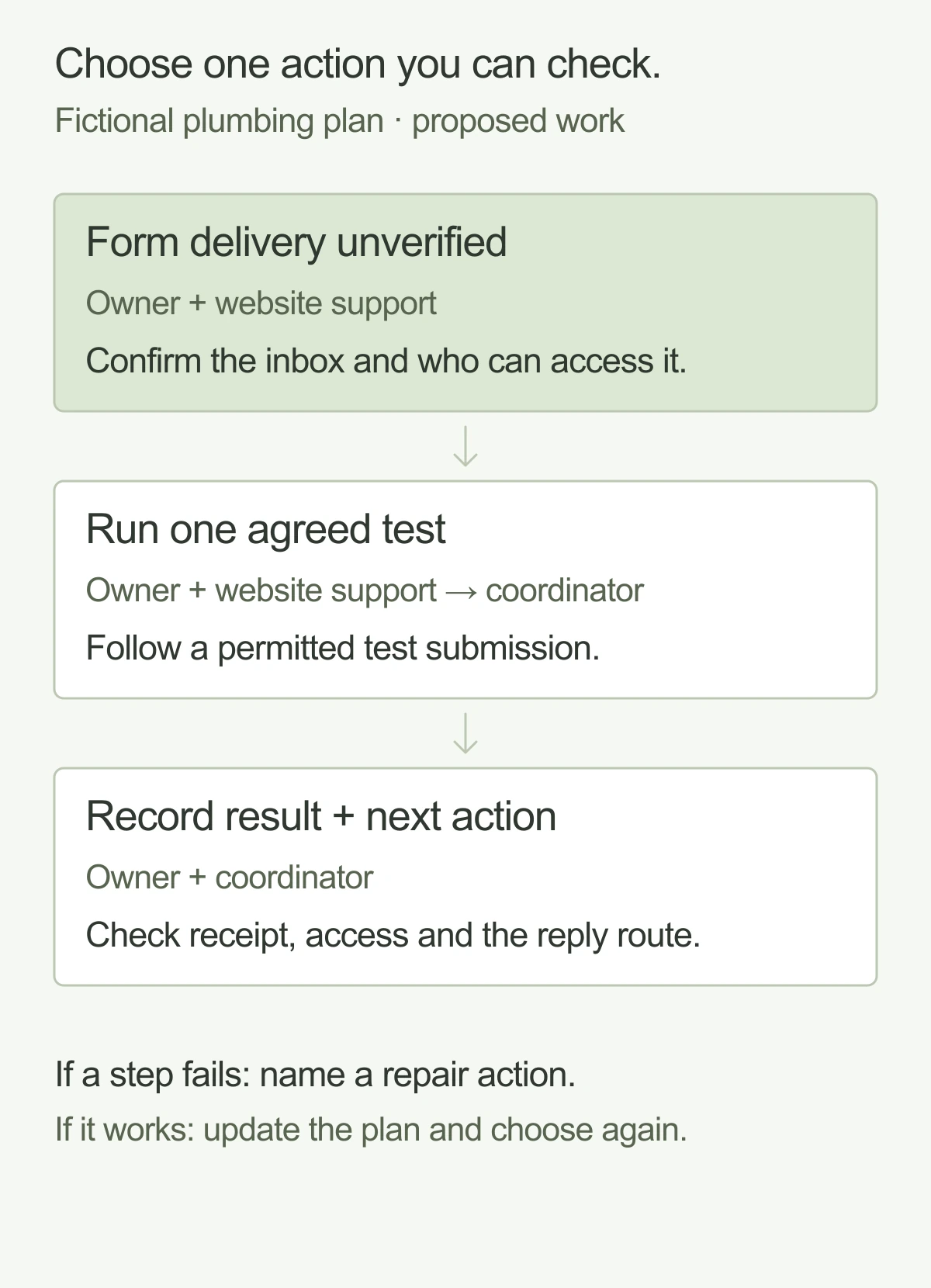
| One next action | The owner and website support contact agree on a test form request. They send it and check that it reaches the coordinator. This step does not include a campaign launch. |
| Review evidence and decision | Check the test record before considering a campaign. Did the request reach the agreed inbox? Can the coordinator open it and reply? If a step fails, name who will fix it. There is no test result yet. |
Follow one test request from the form to the person who should reply. If it fails to arrive, name who will fix it. Then test it again. If it works, update the plan and choose the next gap to address. A passing test shows that this route works. You still need evidence that customers want the service.
Give each planned cost a clear purpose
Before you agree to spend, write what each cost pays for. List marketing work, regular software or hosting charges, and any planned ad spend on their own lines. Ask what the price includes, what you pay directly and what needs a separate choice.
Set a spending limit that fits your business. A general marketing percentage may not fit your needs. If you have not set a limit, name who will set it. List the quotes or facts they need first. A cost estimate you have not approved is still a proposed cost.
Write down your team’s tasks too. These may include sharing project details, getting photo permission, checking copy and replying to requests. A marketing quote does not assign these tasks or mean ad management is included. Agree who will do each task.
Choose one step and plan how to check it
Write the next step, who will do it and when you will check it. Match the check to the task. If you fix a form, test that the request arrives and someone can reply. If you update a service page, check its service, area, proof and next step. Then check which requests fit over a set time.
Swipe or scroll to compare the columns.
| What you find | A step you could take | What to check |
|---|---|---|
| People ask for work in places you do not serve. | Make your area clear on the service page. Check where those requests came from. | The places people asked about, the area on your page and whether later requests fit. |
| People see the homepage but still ask if you offer a service you want to promote. | Improve that service page. Add a clear description, proof that fits and a next step. | Does the page answer the question? Then check whether real requests fit the service. |
| People notice a project post, but the next step is unclear. | Link the approved project story to the right service page and contact route. | Count visits from the post to the next page and real requests on their own. |
Define which requests fit this plan. Include the service, place, kind of customer and facts your team needs to reply. Record requests that do not fit too. For each one, note why. For example, the person may need a service you do not offer or live outside your area. Those requests can show what you need to make clearer.
Count clicks, talks with customers, requests that fit and booked jobs on their own. For example, Google Business Profile counts clicks on the call button as calls. A click alone does not tell you if someone answered or if the request fits. Check your own request and booking records for those steps. Leave missing results unknown.
Copy the one-page marketing-plan worksheet
Fill in the fields for your business. Choose one next step. Name someone to check each missing fact. The text download has this blank plan and the filled-in fictional example.
Service-business marketing plan: one-page decision record
SERVICE-BUSINESS MARKETING PLAN: ONE-PAGE DECISION RECORD
Planning date / review date: ____________________
Service and customer fit / work outside this plan: ____________________
Area you serve / how many requests your team can handle: ____________________
How people could find you / what is checked or unknown: ____________________
Proof you can share / missing permission or proof: ____________________
Service page / service, area and next-step checks: ____________________
Contact route / who gets requests / who replies and covers time off: ____________________
Missing fact / who will check it: ____________________
Owner's spending limit / work, software and ad costs to check: ____________________
ONE next step / who will do it: ____________________
What to check / result / what to keep, change or fix: ____________________
Download the marketing-plan worksheet (.txt)
At each review, decide what to keep, change or fix. Write down why. Check the plan again when your services, area or available times change. Make sure it still fits what your team can do.
Bring the plan to a strategy call
Spring Local brings search, brand, website and social work together. For help choosing what to work on first, book a free strategy call. Bring your plan and current website. Include anything you have not checked yet.
And good people.Meet Spring