
SaaS website redesign cost: what to include in your budget
Compare what a website quote includes, who owns the remaining work, and what counts as a finished launch. Includes two fictional scopes for the same SaaS brief.
 Words by Spring Studio

TL;DR
- Define the finished deliverables before comparing website redesign fees.
- Assign an owner and acceptance condition to each part of the quote.
- Separate the project fee from ongoing software, licenses, and support.
To budget for a SaaS website redesign, add the provider’s fee, work your team must arrange, and ongoing costs such as hosting and maintenance. Confirm which content, design, build, migration, and launch tasks each quote covers before comparing totals.
What does the website redesign quote cover?
A page count is a starting point. Ask which pages need their own layout, which share a reusable design, and which content entries need individual attention. Two sites with the same number of URLs can require different work.
For example, a resource collection may share one article layout while still requiring content checks, image preparation, and migration. Agree how many existing entries will move and who checks them. For design, name the representative page types and the responsive layouts and interaction states to deliver.
Also separate content planning from writing approved copy. A proposal can include either or both. Name who supplies product details, approves claims, and prepares images. Our website redesign checklist covers those inputs in more detail.
Compare two scopes for the same brief
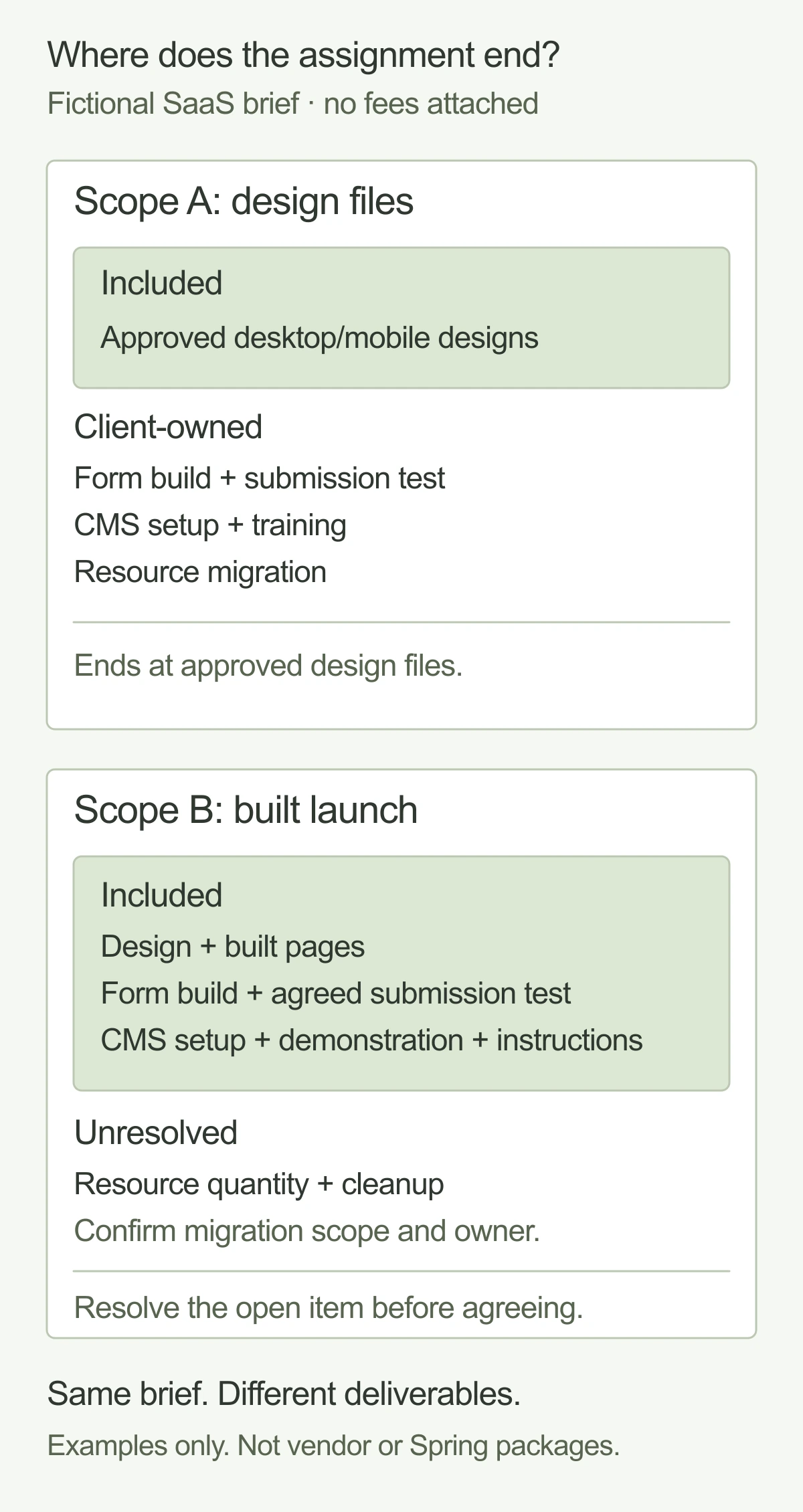
Here is a fictional SaaS marketing-site brief: a homepage, two reusable page types, existing resource content, a demo form, and agreed CMS editing tasks. The CMS is the content management system your team uses to edit and publish. The examples below describe possible assignments; they are not actual vendor quotes or Spring packages.
Scope A ends with approved design files. Scope B includes building and testing the site. No fees are attached because the exercise is to identify the work each fee would need to cover.
Swipe or scroll to compare the columns.
| Deliverable and acceptance condition | Scope A: design files | Scope B: built launch | Owner | Open question |
|---|---|---|---|---|
| Homepage and two page types: agreed desktop/mobile layouts and form states approved. | Included: design files. | Included: designs and built pages. | Provider creates; marketing approves. | Which existing URLs use each page type? |
| Demo form: agreed test submission reaches the named destination; success and error states checked. | Client-owned: implementation and testing. | Included: build and test against the agreed destination. | A: client developer. B: provider. Client supplies destination and access. | Who confirms routing and any required consent wording? |
| Resource content: agreed inventory moved, sample checked, exceptions recorded. | Client-owned: migration. | Unresolved: quantity and cleanup need scoping. | Marketing approves inventory; migration owner still to be named for B. | Which entries, files, and URL changes are included? |
| CMS handover: marketing creates a draft, previews, and publishes a test post using agreed fields. | Client-owned: CMS setup and training. | Included: setup, demonstration, and publishing instructions. | A: client team. B: provider with marketing completing the test. | Which fields, roles, and editing tasks must be supported? |
For Scope A, your budget still needs to cover implementation, migration, testing, and handover. For Scope B, the resource migration remains an open item. Ask for that item to be resolved before treating the proposal as a complete launch cost. Neither assignment is inherently the better choice; the useful comparison is whether it covers the work you need.
Separate project costs from ongoing costs
Keep a one-time project column and an ongoing column in your budget. The project may cover discovery, copy, design, build, migration, and launch checks. Ongoing items can include hosting, CMS subscriptions, asset licenses, maintenance, and design support. Ask which items you pay directly, which the provider bills, and when each starts.
Record the billing basis beside each item: a fixed scope, time-based work, a subscription, or another agreed arrangement. Include applicable taxes and third-party charges in the comparison. A design-file handoff does not by itself establish your rights to every font, image, or other licensed asset.
Resolve assumptions before agreeing the fee
- List included deliverables and exclusions, with a named owner for client-supplied work.
- Record how each deliverable will be accepted: the artifact, task, or test that demonstrates completion.
- Ask how extra page types, revised copy, integrations, and migration changes are quoted and approved.
- Agree review responsibilities, access requirements, launch checks, and support after handover.
If URLs will change, include the URL mapping, redirects, and post-launch checks in the assignment. Keep that work explicit rather than assuming it belongs to either design or development. Use the redesign timeline guide to connect these responsibilities to the launch plan.
Bring a defined scope to the conversation
Spring offers a fixed project scoped together and embedded design support for ongoing work. The pricing page describes the current offers; a general project starting point is not a quote for this fictional website. A useful website proposal names the content, design, build, migration, and handover work included for your team.
If you are planning a redesign, talk with Spring about your website. Bring the current site, the pages and editing tasks you need, and the work your team can own. We can use those inputs to map the assignment together.
And good people.Meet Spring