An embedded creative team or an in-house hire?
Compare the work, skills, and daily ownership your marketing team needs before choosing how to staff it.
 Words by Spring Studio
TL;DR
- Choose an in-house hire when you need a person to own a role inside the company every day.
- Consider an embedded team when recurring work spans several creative skills and an internal lead can set priorities.
- Compare the full workload and responsibilities. A team subscription does not mean unlimited work at once.
An embedded creative team is an outside team that works with your marketing team on agreed ongoing work. It can suit a marketing department with recurring work across brand, web, motion, and campaigns. An in-house hire can suit a role that needs full-time ownership, close company knowledge, and daily involvement in decisions. Neither is the right answer for every team.
Start with what needs to happen over the next few months. Then decide whether you need someone to own a role, a team to deliver a changing queue, or a mix of both. A job title and a monthly fee will not answer that question on their own.
Start with the work your team needs
Pull together the requests from your last two months and the launches you already know are coming. Include the less visible work: updating a sales deck, keeping landing pages consistent, preparing event materials, and adapting a campaign for another channel.
For each request, note the skill it needs, how often it returns, who supplies the content, and who can approve it. Mark any work that depends on access to sensitive systems or frequent product decisions. This is your workload map, not a prediction of exact output.
- Repeated work: What will still need doing after the next launch?
- Specialist work: Which tasks need web, motion, illustration, or another skill beyond your main need?
- Ownership: Who must decide what the brand or product should do, rather than only produce the assets?
- Capacity: Which deadlines overlap, and which requests can wait?
A team that mainly needs a full-time brand lead has a different gap from a team that needs campaign assets, occasional motion, and website updates. Write the gap in one sentence before choosing a setup.
What changes between the two setups?
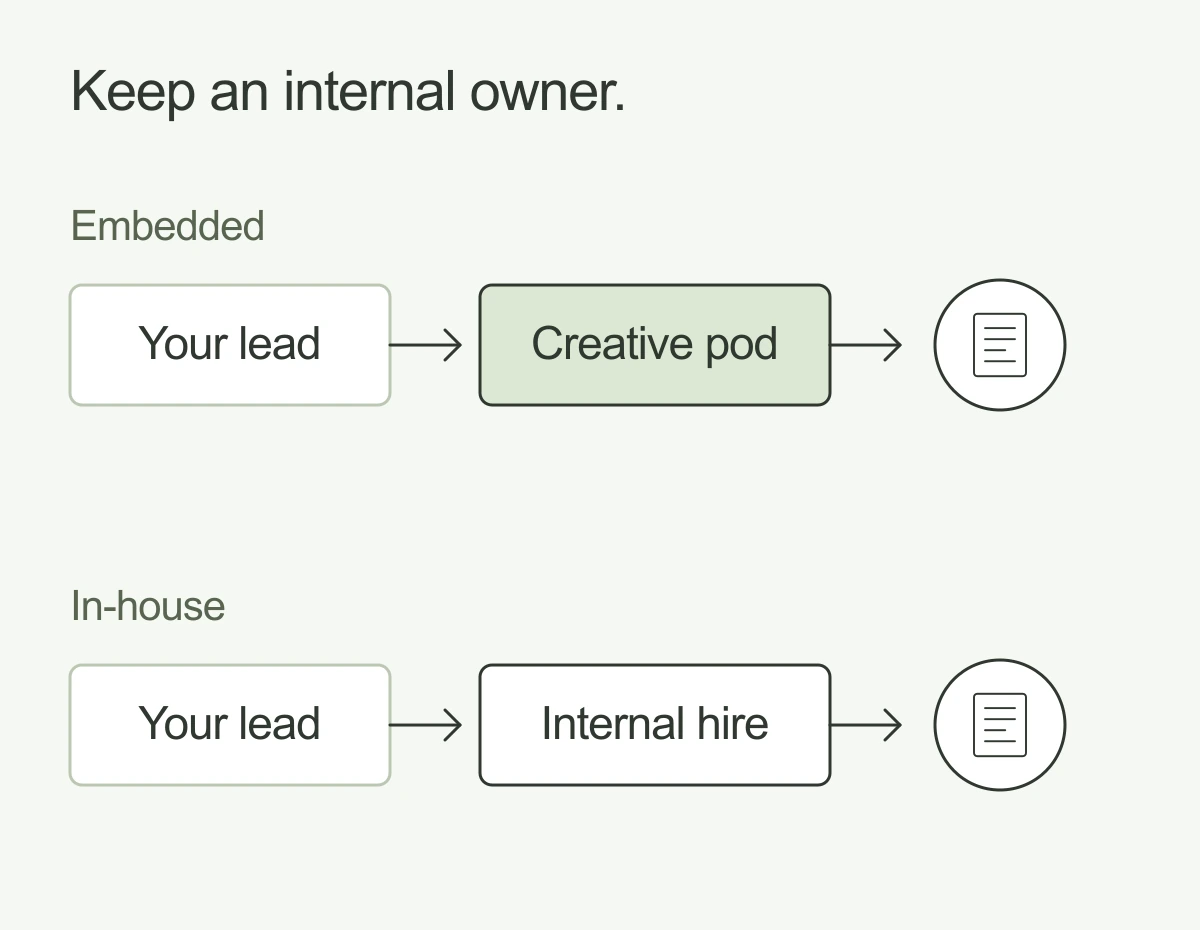
An embedded team works with your company over time rather than learning the business from scratch for every job. Ask what that means in practice: who stays on the account, where context lives, and who is responsible for delivery. The label alone does not guarantee continuity.
Swipe or scroll to compare the columns.
| Decision | In-house hire | Embedded creative team |
|---|---|---|
| Daily ownership | Can own a defined company role and participate in internal decisions. | Owns the agreed creative delivery; an internal lead still owns business decisions. |
| Skills | Starts with the individual’s strengths. Specialist needs may require extra support. | Can draw on the skills included in the agreed team and scope. |
| Capacity | Depends on the role, workload, working arrangements, and cover. | Depends on the engagement’s active-work limits, priorities, and available specialists. |
| Management | Your company recruits, manages, and develops the person. | Your company sets goals and approvals; confirm who manages creative delivery. |
| Continuity | Can build deep knowledge through daily involvement. | Depends on a stable team, shared records, and a clear handover process. |
When an in-house hire is the stronger fit
Consider hiring when the work calls for a person to stay close to company decisions throughout the week. That might mean leading a brand internally, joining product conversations, coaching other designers, or navigating several departments every day.
Write a role around the work one person can reasonably own. If most of the need is brand direction, do not quietly add advanced motion, front-end development, campaign production, and product research to the same expectation. Decide what outside support the hire would still need.
An in-house role also needs management time. Who will set goals, give useful feedback, handle competing requests, and support the person’s growth? Hiring changes where the work sits; it does not remove the need to lead it.
When an embedded team is the stronger fit
Consider an embedded team when the work is recurring, spans several creative skills, and has an internal owner who can choose the next priority. The value to look for is a working relationship that carries context from one request to the next.
Ask how the team moves between disciplines. A campaign may need an idea, a landing page, a presentation, and a short animation. Find out who connects those pieces, who reviews the whole campaign, and where your feedback belongs.
At Spring, the monthly model is built around one active priority at a time. A shared queue helps organize upcoming work, but it does not make several large projects happen in parallel. Check the current scope and terms on our pricing page, and see how our ongoing creative support works.
A hybrid setup can give each side a clear job
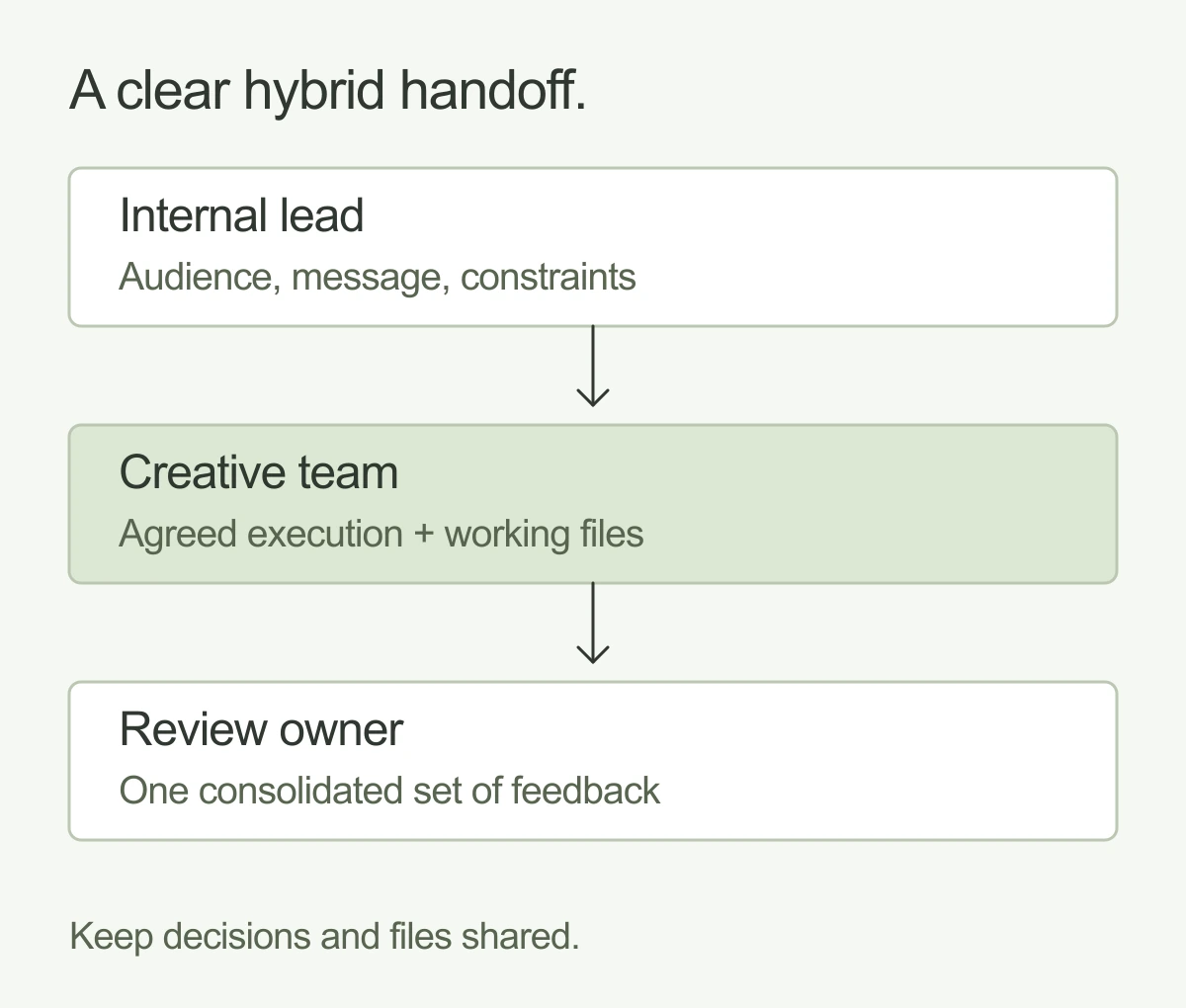
You may already have a strong internal designer who needs help during campaigns or with specialist work. An in-house lead can own the brand, priorities, and internal decisions while an outside team handles agreed production or a specialist brief.
Make the handoff explicit. The internal lead brings the audience, message, and constraints. The creative team owns the agreed execution. One person gathers feedback and confirms approval. Both sides keep the working files and decisions easy to find.
Compare the whole cost and the same scope
Use your own figures over the same time period. For a hire, include pay, benefits, recruiting, equipment, tools, management, and any outside specialist work you expect to need. For a service, include the fee, extra scope, licenses, platform costs, and internal review time.
Then compare what each option can actually cover. A lower monthly figure is not useful if it leaves the main problem unsolved. Equally, a broader team is not automatically better if the job needs one person deeply involved in the company each day.
This is a planning comparison, not a claim that either option is always cheaper. Staffing costs, contracts, and the work itself vary. Use the real proposals and role requirements in front of you.
Questions worth asking before you decide
- Who will make the work, and who will manage delivery?
- What company decisions still need an internal owner?
- How are priorities chosen when deadlines overlap?
- Which skills and deliverables sit outside the role or agreement?
- How will feedback, files, usage rights, and handover work?
- What happens if a key person is unavailable or the workload changes?
Choose the setup from your next few months
Bring the workload map back to the decision. If the gap is daily leadership and internal ownership, define the hire. If it is recurring creative delivery across several skills, compare embedded teams. If it is both, give each side a distinct responsibility.
If the work is one defined launch with a clear finish, read design retainer versus fixed project before committing to an ongoing arrangement. Whichever setup you choose, use a clear creative brief to get the first request moving.
Want to talk through your team’s workload? Bring the next few months to a conversation with Spring. We can discuss what fits, including where an in-house role or a separate project may make more sense.
And good people.Meet Spring